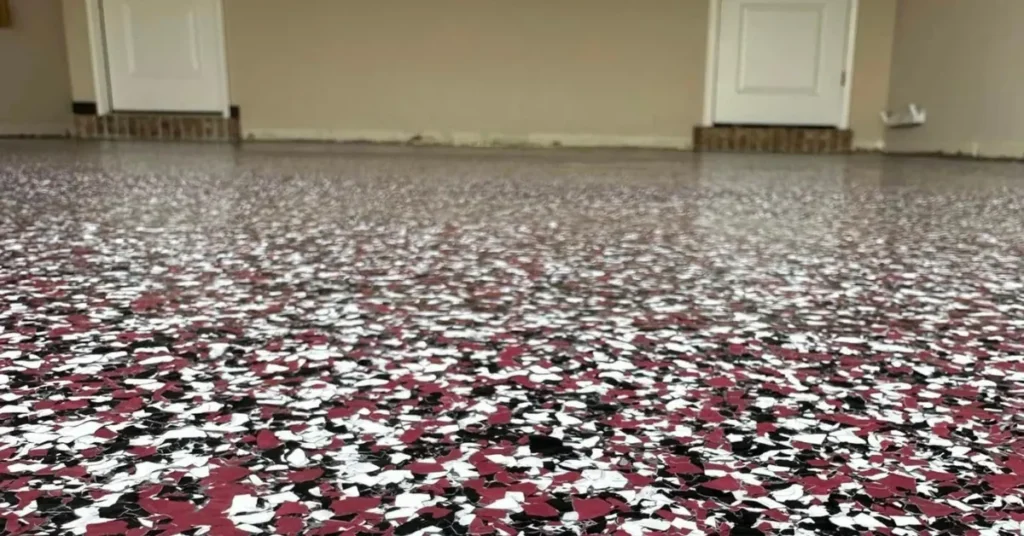
Polyurea and epoxy are both used in professional concrete coating systems. But they are different materials with different properties and different roles.
If you’ve been shopping for garage flooring in Cape Girardeau, you may have seen both terms thrown around, sometimes interchangeably. That’s not accurate. Understanding the difference helps you have a smarter conversation with any contractor you talk to and make a more informed decision about your floor.
What Is Epoxy?
Epoxy is a thick, two-component coating that creates a strong chemical bond with concrete. When the resin and hardener are mixed, a reaction occurs that produces an extremely hard, durable surface.
Epoxy cures slowly, which allows it to penetrate deeper into the pores of the concrete. This is what gives it outstanding bond strength. It is thicker than polyaspartic and polyurea, and most commercial epoxy formulations include a built-in moisture barrier.
Best used for: indoor spaces, garages, basements, and anywhere direct sunlight is not a factor. It is the benchmark for base coat strength in residential coating systems.
What Is Polyurea?
Polyurea is a highly flexible, fast-curing coating. It is not as widely used as epoxy in residential applications, but it excels in specific environments.
Its defining characteristic is flexibility. Where epoxy is rigid and hard, polyurea can flex and move with the concrete. This matters most in cold climates where freeze-thaw cycles cause the concrete slab to expand and contract. Polyurea can move with the concrete without cracking.
Polyurea also cures very fast, sometimes faster than polyaspartic. This makes it valuable for commercial projects where downtime needs to be minimized.
Its limitations: polyurea does yellow over time, though more slowly than epoxy. Its bond to the concrete is not as deep as epoxy. It also has lower moisture tolerance than epoxy. In high-moisture environments, a vapor barrier may still be required before applying polyurea.
Best used for: cold climates with significant freeze-thaw cycles, environments with heavy temperature fluctuation, commercial projects where rapid return to service is needed.
Key Differences Side by Side
| Factor | Epoxy | Polyurea |
| Bond Strength | Strongest | Good |
| Flexibility | Rigid | Highly Flexible |
| UV Stability | Low (ambers) | Moderate (slow yellowing) |
| Cure Speed | Slow | Very Fast |
| Moisture Tolerance | Best | Moderate |
| Cold Climate Performance | Good | Best |
| Common Use | Residential base coat | Cold climate base coat |
Which One Is Better for a Garage Floor?
For most residential garages in the Cape Girardeau area, epoxy as the base coat is the stronger choice. It bonds more deeply, provides better moisture protection, and is the most proven system for standard residential applications.
Polyurea becomes a more relevant consideration in climates where freeze-thaw cycles are extreme. In those conditions, the flexibility of polyurea prevents the base coat from cracking as the concrete shifts through seasonal temperature swings.
In both cases, the top coat is typically a polyaspartic. Regardless of what base coat is used, polyaspartic is the right choice for the top layer because of its UV stability and scratch resistance.
What About DIY Products Marketed as Polyurea?
Some DIY flooring kits sold in hardware stores are marketed as polyurea or polyurea-epoxy blends. These products are formulated differently from commercial-grade polyurea used by professional installers. They tend to be thinner, have lower solids content, and rely on acid etching rather than diamond grinding for surface prep.
Commercial-grade products used by professional contractors are not the same as what is sold in a kit at a retail store. The comparison is not just about the name of the product. It is about the formulation, the thickness, and the process by which it is installed.
The Bottom Line
Polyurea and epoxy are different tools with different strengths. Epoxy is the standard base coat for most residential garage floors because of its bond strength and moisture tolerance. Polyurea is a strong choice for cold-climate installations where concrete movement is a real concern.
Both are topped with a polyaspartic top coat to finish the system.
The most important variable in any of these decisions is who is installing the floor and how they are doing it. The best product installed poorly will underperform. The right product installed correctly will last for years.
FAQ’s
Is polyurea stronger than epoxy?
In terms of bond strength to concrete, epoxy is stronger. Polyurea is stronger in terms of flexibility and resistance to thermal movement. They are different strengths for different conditions.
Can polyurea and epoxy be used together?
They serve as base coat options, not materials that are layered together in the same system. The common professional system is either epoxy or polyurea as the base coat, with polyaspartic as the top coat.
Does polyurea crack?
Polyurea itself is highly flexible and resistant to cracking. However, if the concrete beneath it shifts significantly, the coating can crack along with the concrete. This is less likely with polyurea than epoxy because of its flexibility, but no coating is immune to severe structural movement.
Is polyurea more expensive than epoxy?
Polyurea materials can be more expensive than standard epoxy. However, pricing for a finished floor is driven by the complete system and the installation process, not just the material cost of one layer.
Questions about which system is right for your floor? Contact Cutting Edge Epoxy for a FREE consultation.